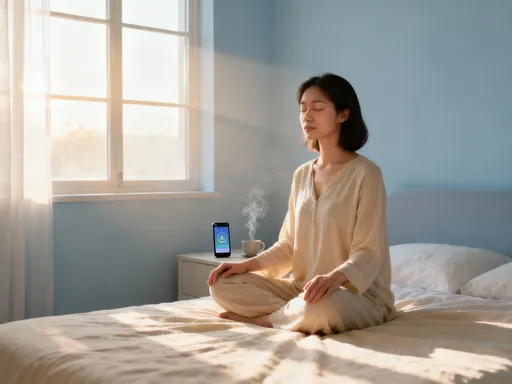
After Using This Meditation App for 3 Weeks, I Finally Learned How to Quiet My Mind
You know that feeling when your brain won’t shut off—lying in bed, replaying awkward moments from 2012, or stressing about tomorrow’s to-do list? I’ve been there, tossing and turning, chasing sleep like it owed me money. Then I found a little app that changed everything. Not with flashy promises, but with gentle guidance that actually fits into real life. No tech jargon, no pressure—just calm. And in just a few weeks, I wasn’t just sleeping better. I was thinking clearer, reacting slower, and feeling more like me.
The Noise in My Head Was Real—And It Was Ruining My Days
For years, I thought the constant hum in my mind was just part of being a woman in her thirties—juggling work, family, home, and everything in between. But slowly, that mental noise started to take over. I’d lie awake at 2 a.m., mentally rehearsing conversations I hadn’t even had yet. I’d forget appointments, misplace my keys three times a day, and lose my cool over things like mismatched socks or a slow Wi-Fi connection. One morning, I snapped at my daughter because she wanted pancakes instead of waffles, and immediately burst into tears. That’s when I knew something had to change.
It wasn’t just stress. It was mental exhaustion. My brain felt like a browser with 47 tabs open, five of them frozen, and someone constantly tapping on my shoulder asking, “Did you remember to…?” I tried everything—journaling, early bedtimes, even cutting out caffeine—but nothing quieted the storm. I wasn’t sleeping, I wasn’t present, and I wasn’t enjoying the life I’d worked so hard to build. I didn’t need another productivity hack. I didn’t need another app that promised to help me do more. I needed to do less—and feel more. That’s when I finally considered meditation, not as a trendy wellness fad, but as a real, practical tool for survival.
I’d always thought meditation was for people who wore linen and lived near mountains. I pictured silent retreats, incense, and impossible goals like “emptying the mind.” But what I discovered was something far more accessible: a simple practice of returning to the breath, again and again, without judgment. And the gateway to that practice? A small, unassuming app on my phone—one I almost deleted after the first day because I was convinced I was “bad at it.”
Why I Gave Up on Meditation—Until This App Made It Stick
Let’s be honest: I’d tried meditation before. I downloaded a few apps, watched YouTube videos, even sat cross-legged on the floor for ten minutes while my dog stared at me like I’d lost my mind. But I always quit. Why? Because it felt like another chore. Another thing to fail at. I’d sit there, eyes closed, and immediately wonder: Am I doing this right? Should I be feeling something? Is it okay that I’m thinking about grocery shopping? By minute three, I’d give up, convinced I wasn’t cut out for mindfulness.
The problem wasn’t me. It was the approach. Most meditation methods felt too abstract, too rigid, or too time-consuming. They asked for 20 minutes of silence when I could barely find five. They used language that sounded like a philosophy lecture. And they didn’t account for real life—like the fact that my kids interrupt me every 12 minutes or that my brain tends to race when I’m tired.
Then I found an app that felt different. It didn’t ask me to transform overnight. It didn’t promise enlightenment. Instead, it treated meditation like training a muscle—something that gets stronger with small, consistent effort. The first session was just three minutes long. Three minutes! I could handle that. And the voice guiding me? Warm, kind, like a friend who knew exactly how hard this was. She didn’t say, “Clear your mind.” She said, “It’s okay if thoughts come. Just notice them, and gently return to your breath.” That tiny shift in language made all the difference.
What really kept me going was the app’s focus on progress, not perfection. It celebrated small wins—“You’ve meditated 3 days in a row!”—and offered gentle reminders instead of guilt trips. There were no red X’s for missed days, no shaming messages. Just encouragement. And slowly, something shifted. I started looking forward to those three minutes. They weren’t a chore. They were a gift.
How This App Turns Mindfulness Into a Daily Habit (Without the Guilt)
One of the reasons this app worked for me—when others didn’t—is that it feels less like a spiritual practice and more like a personal reset button. Every session starts with a simple check-in: “How are you feeling today?” I tap an emoji—tired, stressed, okay, calm—and the app suggests a short meditation based on my mood. If I’m anxious, it offers a grounding breath exercise. If I’m overwhelmed, it guides me through a body scan. If I’m just tired, it gives me a restful visualization.
This personalization made meditation feel doable. I wasn’t trying to fit myself into a one-size-fits-all practice. Instead, the app met me where I was—literally and emotionally. And the voice? Still warm, still patient. She never rushed me. She didn’t make me feel like I was “behind” or “not trying hard enough.” She just stayed with me, breath by breath.
But here’s the real magic: I didn’t realize I was learning mindfulness theory until I started noticing changes in my daily life. Like the day my computer crashed during a work call, and instead of panicking, I paused. I took one slow breath. And then another. I didn’t yell. I didn’t cry. I calmly restarted the system and apologized with a smile. My colleague said, “You’re so unflappable.” But it wasn’t that I’d suddenly become calm under pressure. It was that the app had been quietly teaching me how to respond instead of react.
It taught me about the space between stimulus and response—the tiny pause where we can choose how to act. I wasn’t just learning to meditate. I was learning to live with more awareness, more intention, and more kindness—toward myself and others.
Organizing My Thoughts Like I Organize My Calendar
I’ve always been a planner. I color-code my calendar, write to-do lists in three different notebooks, and set reminders for things like “buy birthday card” and “call dentist.” So when I started using this app, I naturally treated meditation like an appointment—with myself. I scheduled it just like I’d schedule a meeting or a haircut. Same time every day. Same place. No excuses.
The app syncs with my phone’s calendar, so I get a gentle notification: “Time to breathe.” Not pushy. Not loud. Just a soft chime, like a friend tapping my shoulder. And once I started marking meditation as a non-negotiable part of my day, something interesting happened: I began to protect that time. I wouldn’t let a last-minute email or a laundry pile derail it. It became sacred—not because it was long, but because it was consistent.
The app also tracks my streaks—how many days in a row I’ve meditated. At first, I rolled my eyes at the idea. “I’m not a child who needs a gold star,” I thought. But then I hit day 5. Then day 7. And seeing that little number grow—“7-day streak”—actually made me smile. It wasn’t about perfection. It was about showing up, even when I didn’t feel like it. Even if I only did two minutes. The app didn’t care. It still counted.
And just like organizing my schedule brought clarity to my days, organizing my inner world brought calm to my mind. I wasn’t just managing tasks anymore. I was managing my attention, my emotions, my energy. I started to see my thoughts like items on a to-do list—some urgent, some not, all temporary. And instead of reacting to each one, I could choose which to engage with and which to let pass.
Learning Without Effort: How Micro-Lessons Fit Into Real Life
One of the most surprising features of this app is the short audio lessons that play between meditation sessions. They’re only three to five minutes long, and they cover topics like “Letting Go of Perfectionism,” “Handling Criticism with Grace,” and “The Myth of Multitasking.” I didn’t sign up for a psychology course—but somehow, I’m learning one anyway.
What’s brilliant is how seamlessly these lessons fit into my routine. I listen while folding laundry, waiting for the school bus, or stirring soup on the stove. No extra time needed. No homework. Just little nuggets of wisdom that sink in without me even trying. I remember one lesson about how the brain treats imagined stress the same as real stress. That hit me hard. I realized I was spending hours worrying about things that hadn’t happened—and my body was reacting as if they were real emergencies.
These micro-lessons didn’t make me an expert in mindfulness. But they gave me tools—simple, practical ideas I could use right away. Like the concept of “mental time travel”—how we waste energy regretting the past or fearing the future. The lesson suggested a simple practice: when I notice my mind wandering, gently say, “Back to now.” I started doing that. And it worked. Not every time, but enough to make a difference.
What I love most is that I’m learning without pressure. No tests. No grades. Just knowledge that builds over time, like layers of paint creating a fuller picture. I’m not trying to be perfect. I’m just trying to be aware. And slowly, that awareness is changing how I move through the world.
Sharing Calm: How My Family Noticed the Change
I didn’t tell my husband I was meditating. I didn’t make a big announcement or ask for quiet time. I just started showing up differently. And after a few weeks, he noticed. “You seem… lighter,” he said one evening. “Like you’re not carrying the whole world on your shoulders anymore.”
Then my daughter said something that made me laugh and cry at the same time. We were in the car, stuck in traffic, and the GPS rerouted us for the third time. Normally, I would’ve muttered, “Why can’t this thing get it right?” or snapped, “Just pick a road!” But this time, I just took a breath and said, “Okay, new plan. Let’s see where this takes us.” My daughter turned and said, “Mom, you’re not yelling at the GPS anymore. Did you get a new car?”
Those small comments told me everything. I wasn’t just feeling calmer. I was being calmer. More patient. More present. And that shift didn’t just affect me—it changed the energy in our home. I started inviting my family into the practice in tiny ways. Before bed, I’d say, “Let’s do two minutes of breathing. No rules. Just close your eyes and breathe with me.” Some nights, my daughter lasts 30 seconds. Other nights, we make it to two minutes. But it’s not about the time. It’s about the connection.
My husband even joined once. We sat on the couch, hands on our laps, breathing together. No talking. No expectations. Just being. And in that quiet moment, I felt something I hadn’t in years: peace. Not because everything was perfect, but because we were all here, together, not rushing, not reacting, just being.
This Isn’t Just an App—It’s a New Way of Living
Looking back, I didn’t just gain better sleep or sharper focus. I gained something deeper: a sense of agency. Not over my schedule, my kids, or the chaos of daily life—but over my own mind. The app didn’t fix my problems. It didn’t make my to-do list shorter or my commute faster. But it gave me the tools to face all of it with more grace, more patience, and more presence.
Now, when stress hits—when the dog chews the homework, when the oven breaks, when I get a difficult email—I don’t spiral. I pause. I take a breath. I ask myself, “How do I want to respond?” That tiny space between stimulus and reaction? That’s where my power lives. And that shift—from automatic reaction to intentional response—has changed everything.
This app didn’t turn me into a zen master. I still forget things. I still get frustrated. I still have days when I want to hide under the covers. But now I have a way back—to calm, to clarity, to myself. And it all started with three minutes a day. Three minutes of breathing. Three minutes of stillness. Three minutes of being kind to my mind.
If you’re feeling overwhelmed, if your thoughts won’t quiet down, if you’re running on empty—know this: you don’t need to change your whole life. You just need to start with one breath. One pause. One tiny moment of stillness. Because sometimes, the smallest changes make the biggest difference. And you don’t need a mountain retreat or a perfect schedule. You just need your phone, three minutes, and the quiet belief that you’re worth this time. You’ve got this.